8 August 2011

London political weather forecast 2


Monday 8th August, evening.


Grouping clouds meet developing smoke. Fires further south.

A chance of increasing helicopters across Hackney and Greater London.


Sirens and constant whir overhead.

London political weather forecast


Saturday 6th August, evening

Riots in Tottenham Hale.
Rainbows in Hackney Central.
Sirens moving north.

26 July 2011

The office: a journey in percussion

The internet has a worming effect on your body and mind, burrowing in between them and creating gaps or channels where you thought there was harmony. Your mind moves at a million miles an hour; it tries to make the body void and null. Nowhere have I more acutely felt this than in my part time job with a company which exists solely to play Google, and make its clients more prominent in cyberspace.

Sitting down and staring at one thing for such a long period of time is unnatural. The dull thrum of your nerves pulsing into the swivel chair, the self-prohibited desire to get up and run around or at least laugh at loud a lot, forms a kind of bass-kick somewhere in your body. Fingers absentmindedly flicker and snap. Mouths open and close silently. The pace and length of the strides from the kitchen to the desk to the toilet quicken and slacken.

Far from this activity dulling or diminishing the body's natural energy - it simply short circuits it. The energy and movement which might power a human body is harnessed to one spot, given a very short leash, and HAS to be rechannelled - into spasmodic eructations on your phone, trips to the toilet, another cup of tea. The office becomes a music and a dance. A duet between body and computer, a dialogue of energy between collective and individual; a flurry of tap-tap-tapping keys and click-click-clicking heels, with the snare and slide of a chair across the carpet.

This short-circuiting of my energy usually leads me, with that internet conditioned click-it-and-see impulse, to YouTube, and music. Whilst I previously thought that my listening choices were a little freedom amidst the invisible office straitjacket, I've realised that music does more than that for me.

I tend to listen to similar songs when I'm working; and I think that the music I choose does what my body wishes it was doing. The music is movement - in sound rather than action. It dances for me, for all of us and our short-circuited energy. I wonder whether the songs I choose chart this daily journey, of body and mind slowly splitting, admitting (or not) to a common beat and re-emerging in time for the end of the day.

A typical morning starts somewhere like here. There's a sense of unity, or openness. Words and rhythm are in a half-blended haze, something optimistic and straight forward, the heat and awareness of the outside enters the office and rules it for the first half an hour.

Then that soulful sunniness sits down, settles and things become more insistent - that beat becomes more regulated, just as the office has clicked into gear and is clap clap clapping through. Meanwhile, the individual, like the voice of Pharoahe, kicks away from that rhythm, unconsciously or not. The harmony of the first half hour dissipates as body and mind split.

And then the mind kind of takes over. The beat quietens down as the office subdues, caffeine buzzes trickle away, and like an unstoppable stream, the random synapses of the over-stimulated mind kicks in, clicking between two screens, or 23 open tabs across 4 windows, emails, scorecards, Google results. A collection of divergent references and unfinished thoughts, like Def here skipping from disco to techno to soul and back. (This video reminds me of an internet-era Beckett's Not I: a disembodied mouth that can't do anything but let the thoughts pour out unstoppably, constantly distracted and shifting. The rhythm, the chaotic monotony of being online.)

But inevitably, this surge fades away into a dulled almost-silence, just the hums of the piano (or, in my world offline, the computers). Confronted with the mind at a dead-end, and a body switching off. At this point, an attempt to jump out of the lull by imagining or identifying yourself with a class, a drama, or a struggle, that will make you feel authentically real, or turn the dull feeling into an identifiable story. But this is self-dramatizing and little more.

It's after lunch and there's still several hours to go. Blood pumps around the stomach and the office is slumped, echoes of the morning (like Burial's traces of the night before) reverberating gently and muggily around the desks. That post-eating haze, as workers finally all arrive back from their breaks, begins to wear off and the first beats of the afternoon settle in. A metronomic pulse overlayed with tiny offshoots and tributaries, as some sink further into the monotony, and others pick up and propel themselves into meetings or tea breaks.

By this point, the montony has become kind of fun. So consistent and strong that you can build off it. My wayward mind has started finding ways to do what I like without paying too much attention to the work I have to complete. I begin to care less about the overall thrum and more about how I can fit new rhythms and ideas into that steadiness, without being caught out.

And by this point, we're less than an hour before the end of the day, and I can feel it. I can't quite pay attention to the beat of the overall office anymore, because a fidgety feeling takes over, itching in and around, resisting any steady rhythm. I go get a glass of water. I sit up, I sit down. I have a chat with a colleague. Everyone begins to splinter, recovering tiny gestures, motifs, and overlaying them on the general office monotony.

This persists, revs, and releases itself, deliriously scattershot onto the streets outside, meeting a thousand others, and cycling home.

25 July 2011

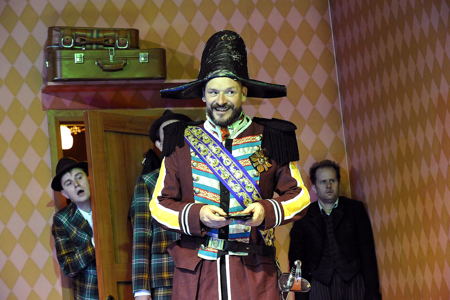
Missives from Months Lost: The Government Inspector


This was on at the Young Vic in June, and to be honest, I haven't thought about it much since, so I can't imagine typing up my original scribblings will be much surprise.

A Study in Deference
'in defence of deference'

Typified by its unwillingness to probe or question its (undeniable) stars. Julian Barratt, poor man, who looked desperate to be given something other to do than lope around stage and pump his fingers into his palm whilst trying to get his lines out as quickly as possible without forgetting them, is a wonderful actor wasted. It felt like he came to this looking for a challenge and a chance to explore a more body-ful way of performing not used in the facical tics and wonderful timing of his TV work - and was instead greeted with a cynical campagin on the YV's part to sell, at all costs, this show as 'The Mighty Boosh''s Julian Barratt. Just likethe poster.

(The audience was certainly comprised of people in their mid 20s, mostly in suits, who seemed to be waiting for subtle Boosh references and had perhaps been big fans at uni when the show first came out.)

It felt like he'd been directed to be Howard Moon and nothing else. You saw glimpses of him leaping out of that oddly ill-fitting demeanour (go with your instincts, Julian! You're right! Acting for TV isn't what you want to do on stage! Don't listen to or worryn about what the director tells you!) - at the very end a physical and vocal spasm as the realisation of the Mayor's mistake dawns on him. Like a jolt of electrivity had been shot through him, Barratt fitted and convulsed, the words coming out so much easier and truer because he wasn't thinking about them. He was doing.
He doesn't strike me as a prima donna, so it's curious that the direciton showed such deference to him + his career - ultimately suggesting a lack of faith. "Just do what you normally do, Julian" stops being a mark of respect 9even sycophancy) and becomes if unchecked, a tool of fear/ A director scared to push a performer and a performer suddenly scared that s/he can't do anything else. Then the words become terrifying, tangible: like the ghost-train neon INCOGNITO which flitted around the walls of the mayor's home.
Kyle Soller meanwhile had the life of 6 people flowing through his wiry frame. I could not take my eyes off him - neither could the audience nor the rest of the cast.
I ddin't completely understand the mish-mash design either - at once retro then clashingly futuristic, or rahter, very 'nowness', with its cut-and-paste references and mingling of aesthetics which ultimately left it feeling oddly styleless...?

Really, I thought it would be less boring.
And more funny.

It seemed that the mayor's anxiety - so potent in the play - had influenced the rest of the skittish productions; with the exception of the bottle rocket 'Government Inspector' - an enigma in the cast and an enigmatic expception to the other largely strained performances.

Kyle Soller, on the otherhand, was the reason for not leaving at the interval. He was mesmeric, and had the effect of a sports star or a dancer at his or her best, who you simply watched open-jawed with their virtuosity. His energy was the kind that, for two hours, makes you fall completely in love, forgiving everything else around you.

Missives from Months Lost: The Passion in Port Talbot

Back in April, National Theatre Wales, a company that really explores and expands old binary ideas of what a 'national' theatre is, with a real openness and curiosity about how Wales as a country and the company as a group of artists can work together, finished up its inaugural year with The Passion in Port Talbot, a 3 day festival, sort-of-but-not-quite recreating elements of the Passion in this South Wales town by the sea.

I had tickets for the opening day - Friday 22nd April - and then ended up coming back the next two days as well (though I missed bits and pieces.)
Anyway, this is from the floor of Aberafan Shopping Centre on the Saturday 23rd, in a break between 'scenes'.

What is brilliant is the bodies of the people - the social body - the polis

First day, first performance: nervous, shuffling and obedient
by Saturday 3.44pm they're sitting on the floor of the shopping centre - a real accidentally -on-purpose sit-in relaxed and non-conformist in a way that they won't even notice
maybe they do notice maybe - maybe their feet and their torsos and shoulders feel different - perceptibly to me imperceptible to them or vice versa who knows
but from where (and how) I stand, this event is relocating and rearticulating the crooked social body, giving different and new flight to a mangled group of people who are not in themselves broken or mangled at all, but impinged upon - by the overpass, by the steelworks, by economic recession, by an undeserved reputation
but a body will fly again will pick itself up - it does not need to reconstitute BECAUSE IT IS NOT BROKEN IT IS NOT FRAGMENTED NO
it is squashed and all it needs to do is stretch once more; stop crouching, lift the head and elognate the spine, raise the head a little closer to the blue skies, relasing the lungs and the diaphragm letting the fresh(ish) air in and in this new - yet age-old - stance, TAKE A STAND, make itself stand up and sing unstoppable but also inevitable


it isn't about a lack or an abolition of control it is about a recolation
[ A RELOCATION where there is usually DIS-LOCATION


putting our head back on the shoulders
+
breathing in
not forcing up and out but by nature
being empowered rather than experiencing power as a bitter gust that rallies under the doors and through the pillared corridors created by the overpass -
taking breath - inspiration - a movement of air from within + without the body itself, chemically, naturally connecting inside + out; shared + minutely individual
not just the hot blasts of gorgeous wind on Aberavon beach, nor the whistling whirs of the M4 traffic but air (dirty and clean) that passes through the many membraned insides of the flesh+blood human beings who live amidst the concrete + sea somewhere between industry & nature
AND THAT'S WHERE + HOW THEY MUST STAND UP NOW -
not bi-partisan, not pro-mountain, anti-M4, not pro-sea, anti-steelworks, but somewhere, something uniting the two, something that acknolwedges history + economy's impositions & recognise that these people & this nature has absorbed these things - suffered but SURVIVED: a regenerative, mournful but maybe maybe changing process, generous process which industry cannot perform no
NATURE, human nature, can & does suffer these impositions: it is generous (sometimes too generous) and quiet (sometimes too quiet) in ceding a place to all these inventions

industry in its arrogance imagines it has won. imagines it dominates the landscape. Imagines that the story is its own. But one look at the beach at Aberafan tells you different. This is Nature's story - whether a tragedy or a comedy, or something unheard of before, this is not about industry. Industry does not win. Industry is incoporated. It is a theme, perhaps, a well-realised motif.
But Nature is all: subject, object, within + without, wheezing as well as singing, patching itself up even whilst it is being torn apart.
This is a passion of mine.
It's pretty clear that the 'story' being written about isn't the narrative of the piece of theatre, but the impulse of the event itself. The story of the people of Port Talbot. The story of Nature and Industry battling over human beings' lives.

I remember a sudden, massive response to the feeling, of being one of and with the people and the history of the town in some ways - and perhaps surprise at experiencing that feeling. Of great pride and faith and connection to the people and the landscape, and being part of that somehow, not just as an audience member, but as someone born and brought up down the road, who went to the town's Lido a few times, but mostly drove over it, as most do, to get to Swansea, or back home to the Vale.

I could never write any kind of 'review' of the show. That said, I thought Lyn Gardner did a non-job of it here - especially to give it 5* then give little more than a summary of what happened. As a piece of theatre - a dramaturgical whole - it didn't make a whole lot of sense.

And if I judged it as a cohesive show then I don't think it would stand up so well. But then it took place across so many platforms, and involved so many times and places that it was not possible to see everything. And certain elements were simply interactions with other people, with Port Talbot community groups and so on. There were moments of great beauty and well-crafted poise - Owen Sheer's writing for the Llewellyn Street passage was stunning, as ghosts of the town, people unhoused by the building of the overpass, emerged from the pillars of the M4 to rebuild, by imagination and voice, the homes they once knew.

Yet for the most part, we were running around in the hope that something would become clear that never quite did. The traditional passion stuff all happened - but this didn't quite weave into what the narrative was trying to do (so we have a slightly inexplicable 'punishment' of an amnesiac Teacher who refuses to take responsibility for being involved in a uprising in the town - crucifixion!). Really, Port Talbot was Christ in this story, and my only wish was that this had been more fully committed to and explored in fabric of the piece. Still, as an event, a community gathering, it was second to none. And perhaps even trying to judge it, or understand it, as some kind of narrative whole or dramaturgical pattern, is ridiculous when considering thousands of people. In many ways it was a patchwork - a reflection of the different (and soemtimes conflicting) expectations of what the participants were making - of theatre, song, spectacular, promenade, fete, funeral, film. Its power was what it did to and for people.
A rightful celebration.

20 July 2011

Missives from Months Lost: Un peu de tendresse bordel de merde


My brother was staying the night I saw this. June 3rd 2011. I hadn't seen him for ages and I knew he was at home with wine and food and friends, so my mind wasn't on this show. Plus I'd had a really good day of workshops with a group of TDA alumni, and I just wanted a beer in the sun.

The Sadlers Wells website says:

Un peu de tendresse bordel de merde! is about the search for love and the human form. Using humour to tackle taboo subjects, it features 20 dancers, naked both literally and figuratively. A narrator leads the audience on a journey through their emotions as the performers leap with a primal urgency, or lie crumpled and defeated on the ground, before climaxing in a breathtakingly beautiful and moving finale.

I failed to make it that far -I made to an hour and twenty minutes then had to leave. As soon as I got on the bus I started scribbling -

So little to do with either ferocity, brutality or tenderness that perhaps that's what kept the audience: there must be something coming, there must be something.
It hated men and it hated women. And it seemed to hate itself but not in any way that might have illuminated or changed our attitudes or lives. Not at all.
Not even the sensational or the sensationalist. It made me feel scared of sex and intimacy and other people. It worried - no it confirmed, in those 80 minutes - a (ridiculous and unfeeling) notion that human beings just want to hurt each other or consume everything in one gulp. There was no link, no real judgement or new message or revelation about how humans are or why humans are the way they are. Even a disrespect of the dancers, their faith and their bodies. Because we never saw the bodies being honest or open

NUDITY

but never nakedness. Not rawness. Not a truth. Not one truth or exposure.

The opening five minutes very promising - an impassioned and desperate attempt to breach an impasse - the woman reaching and grabbing more and more for the other, seeking tenderness. The first man's passivity = symptomatic of the whole show. Its complete lack of empathy, compassion or the HUMAN. As he turned his back on this heaving woman's body so too the entire piece turned its back on us and on 'tendresse', never to make any link between why a disconnect between audience and performer, lover and lover, consumer and product MIGHT ACTUALLY BE WORTH DANCING ABOUT. it made life feel redundant.

...

why does a show like this gain so much press? because the idea of parading nudity as an 'idea' is so totally unexamined by a bodydead/braindead society and media that we give it the kind of credence and authority it NEVER MERITS NOR WORKS FOR.
We've been flipped over and fisted into submissions, not penetrated by anthing resembling something reproducutive something that might generate ideas, seeds, new connections.

A lot of that writing is a bit cringy and extreme, in retrospect. But it did manage to hit a really tender nerve, not of outrage at nudity (yawn) but outrage at how it treated people. I think it's the only show I can remember having left before the finish. It also sounds like the angriest I've been in a while. I remember bubbling and boiling on the bus.

What was the most irritating was the feeling of exploitation. For a brief second I regretted leaving, thinking that perhaps the finale was a worthwhile tonic. But then emerging onto the street, several others had already given up and were having cigarettes outside, with haunted and exhausted looks. They weren't going back either; what came before was enough to make it beyond redemption. Jenny Gilbert's review in the Independent:

The tone darkens markedly after the cast put their clothes back on. In a crude steal from Pina Bausch the men shout "Frappe-moi!" and hit themselves hard in the face, over and over. In another sequence, Sabrina is offered the choice between a man and a chocolate cake. She takes off her knickers and goes for the cake.

I remember that bit. Just before I tipped over the edge. And whilst very often the intense anger I feel watching a show gives way to a more sustained realisation after I leave, I still think the same thing about Un peu de tendresse. I just feel a lot less. And what did the haunted smokers and I miss when we left? Not much, it seems:
Despite the plea implicit in its title, there is a good deal more bordel than tendresse in this long and often tediously barbaric show. Only in the final minutes does peace descend, as the 24 dancers, naked once more (but who really cares?) skid silently about the wet stage surface like seals at play, finally curling up as happy couples.

Missives from Months Lost

At the risk of suggesting that I spend all of my time at Sadlers Wells, I've decided to publish a few missives from months gone by.

It's an experiment in blogging. I'm curious to see what something retrospective does in a realm as present-and-future-tense as cyberspace.

We'll see.

I tend to see a lot of things, or have a lot of thoughts which are scribbled down passionately, then by the time they arrive on a computer screen, an email inbox, an article, they've been tailored and made cohesive - or reductive. With a mixture of bravery and stupidity, I want to see my scribblings word for word alongside my typed thoughts today. Less writing in the past, more putting two presents together.